Rohini Knudson
SPED Professional Portfolio
Structured Teaching
The Culture of Autism
A conceptual framework that looks at autism as a different way of being characterized by variations from the norm in thinking, feeling, communicating and experiencing one's environment.
An educator' s role is to teach their autistic students how to successfully survive in a world designed by people outside of their culture.
Structured Teaching
An educational approach that uses structured environments and systematic strategies to make learning more accessible and effective for autistic learners. It capitalizes on the strengths of autistic learners such as their ability to follow routines and to process visual information.
By making the environment more predictable and clarifying expectations with visual boundaries and supports, it decreases anxiety in the learner and increases independence and engagement.
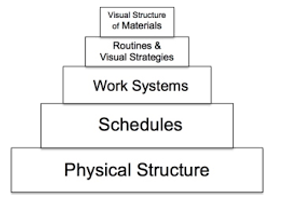
Structured Teaching Pyramid
TEACCH Program
Developed by Eric Schopler in 1972, the Treatment and Education of Autistic and related Communications Handicapped CHildren (TEACCH) was initially a state-wide program in North Carolina but now serves as a model for other communities in assisting autistic individuals and their families throughout their lifespan. The program uses structured teaching principles of organizing the physical environment and developing appropriate activities to help individuals of all ages understand what is expected of them and how to function independently (VanBourgondien, ME & Schopler, E, 1996).
The structured teaching pyramid (shown above) is a visual depicting the 5 elements of structured teaching that build on top of one another, all emphasizing predictability and flexible routines in the classroom setting (Mann, L. B., & McKeithan, G. K., 2024).